

Why Social matters (and when it doesn’t)
UGC and social sourcing is extremely industry-dependent.- In some categories (often DTC and consumer purchase prompts), AI relies heavily on community threads, reviews, and social discussion.
- In other categories, AI relies mostly on editorial sources, official documentation, and company pages, and social sources rarely appear.
- If Social is a meaningful driver, Social is high leverage.
- If Social rarely appears, Social may be secondary to Outreach and owned source pages.
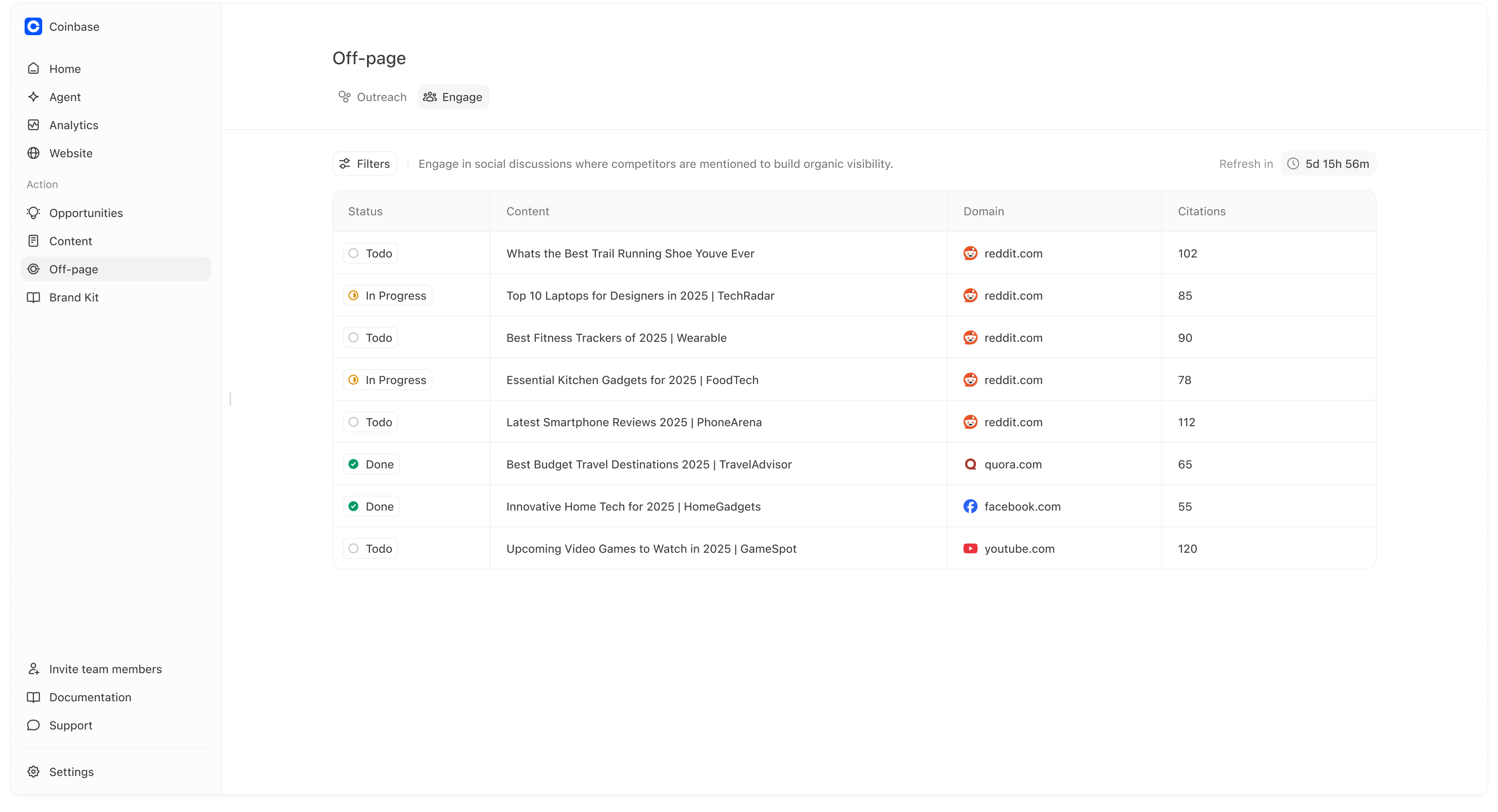
How the Social list is generated
Social is built from the same citation ecosystem as Outreach, but filtered to social/community sources:- It starts with the social/UGC pages that are most cited for your prompt set.
- It focuses on the pages that are already shaping answers (not generic “influencer lists”).
Two common ways teams use Social
1) Engage with existing posts that AI already trusts
This is the highest-leverage use of Social. When you contribute to a thread that is already being cited for a prompt you care about, you are adding language directly into the evidence pool AI uses. A strong engagement contribution usually includes:- a short decision framework,
- trade-offs and safety considerations,
- concrete facts and specifics (not marketing language),
- and clarifying context that matches what the user is asking.
Linking to your website is often less important than the language itself. In many cases, the text you add (clear criteria, differentiators, factual claims) matters more than the link.
2) Use Social as inspiration for what to post next (and where)
Social is also a research surface. The goal here is to learn what AI is already trusting from social/community sources, then use those patterns to publish better social content yourself (and improve your owned content where it matters). Use Social to learn:- what questions repeat,
- what objections come up,
- what language people use to compare options,
- and what criteria the prompt seems to care about (price, durability, trust, ease of use, etc.).
A) Turn this into your own social content plan
Use those patterns to create a steady stream of posts on the platforms AI is already citing. In practice, teams use Social to decide:- What to post: the top recurring questions and comparison criteria (turn each into a post).
- How to frame it: the exact language and trade-offs people use (mirror it, but add clarity and proof).
- Where to post: the communities and platforms that show up in Social (those are the ones most likely to influence answers for your prompt set).
- “Decision framework” posts (“If you care most about X, choose Y”)
- “Trade-off” posts (“Cheap vs secure vs fast—what you give up”)
- “Myth vs reality” posts (address the most common objections directly)
- Short comparison posts (you vs competitor, with clear criteria)
The goal is not to drop links everywhere. It’s to get accurate, differentiated language into the places AI already trusts.
B) Use the same patterns to improve your owned content too
The same themes you see in Social are often exactly what your website needs to cover to become more citeable. Use those patterns to improve:- your FAQs and schema on owned pages (**Website → Pages**),
- your content briefs and listicles (**Opportunities / Content**),
- and your comparison criteria and “best for” positioning (so you rank higher when you are mentioned).
How to engage effectively
- Pick a page that is cited for a prompt you care about. If the page is not in the citation ecosystem, it is usually less impactful.
- Be helpful first. Focus on giving the best answer in the thread. Avoid promotional tone.
- Use specific language that matches AI prompt criteria. If the prompt is “best X for beginners,” your comment should address beginner criteria (ease of use, learning curve, support, pricing clarity).
- Reference a link only when it genuinely helps. A link is optional. If you include one, link to a source page that supports your claim.
Example engagement approach
If the thread is “best exchanges for beginners,” a strong comment includes:- a short decision framework (what to optimize for),
- trade-offs (fees vs simplicity vs security),
- and factual differentiators that are easy to repeat in an AI answer.
Setting expectations
Social is a leverage play, not a guarantee. Adding your brand name to a thread does not automatically increase visibility. Outcomes depend on factors like:- whether the page continues to be cited for your prompt set,
- whether your contribution aligns with the criteria AI uses in answers,
- whether competitors still dominate the cited sources,
- and whether your owned pages are citeable when AI wants proof.
Think of Social as “shaping trusted language.” The best results come from consistent, high-quality participation on a small set of high-impact pages over time.
Refresh cadence (weekly)
Social targets update weekly based on the past week’s citation data. As new threads trend and old ones fade, your target list will change.Measuring impact
You will usually see impact in this order:- More inclusion or visibility in the engaged threads/pages.
- More appearances in citations (Analytics → Citations) if those pages remain drivers.
- Better prominence on prompts those sources influence.
- Visibility increases across related prompt clusters.